
Why Developers Order an ALTA Survey Before Talking Site Plans
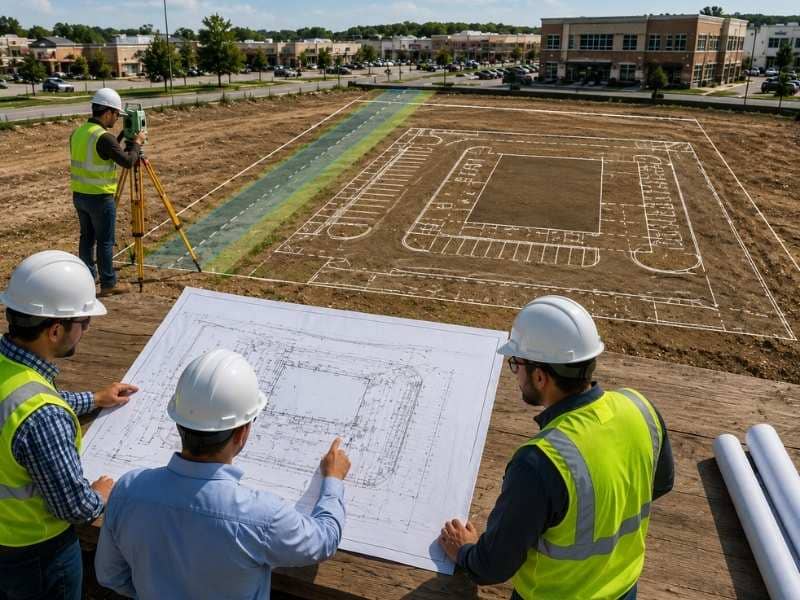
Every commercial site plan rests on a set of claims about the property: where the boundaries run, what easements cross it, how vehicles get in and out. An ALTA survey is how experienced developers prove those claims before an architect draws a single line. Ordering it first feels slow to teams eager to see concepts on paper. Skipping it produces something worse than slow. The result is a polished site plan built on facts nobody verified, headed into a review process that will check them anyway.
Site Plans Need a Base Map That Tells the Truth
A site plan is only as reliable as the drawing underneath it. Architects and civil engineers who start from assessor parcels, old plats or aerial imagery are designing on guesses. Commercial layouts leave little room for guessing. A building footprint, drive aisle and stormwater pond packed onto a tight parcel can all shift. It only takes a true boundary landing a few feet from where the tax map put it.
The ALTA survey replaces those guesses with fieldwork. It documents the boundaries, the recorded easements, the improvements and the access as they legally and physically exist. Developers hand that drawing to the design team as the base map. Every concept that follows already fits the real property. Optional add-ons like contours, utility locations and zoning details can ride along on the same survey when the design team needs them.
Easements Decide the Buildable Envelope
Before anyone debates building placement, the property has already made some decisions. Recorded easements for utilities, access and drainage carve out strips of land where nothing permanent can go. Setbacks shrink the canvas further. The ground that remains is the true buildable envelope. It’s often smaller and stranger in shape than the raw acreage suggests.
The ALTA survey plots each recorded easement in its actual location. That’s exactly what a concept plan needs to respect. A developer who knows the envelope early can test whether the intended building, parking count and traffic flow even fit. A developer who learns about a thirty-foot utility corridor after the concept exists gets to start over. The second version rarely pencils as well as the first.
Reviewers Check the Same Facts the Survey Establishes
Site plan review runs on checking facts. Planning staff and consulting engineers compare the submitted plan against boundaries, easements, access points and existing conditions. They flag every discrepancy they find. A plan drawn from verified survey data sails through that comparison. A plan drawn from assumptions collects comments. Each comment letter buys another resubmittal cycle measured in weeks or months.
Commercial site plan approvals also tend to involve several reviewers at once, from planning to public works to the fire marshal. When all of them work from a plan anchored to the same surveyed base, their comments stay on design questions. Factual disputes never enter the thread. That single shared version of the truth is one of the quietest schedule protections a project can buy.
Ordering Early Protects the Approval Calendar
An ALTA survey takes real time to produce, since it involves title research, fieldwork and careful drafting. Developers who order it at the start of due diligence have the finished drawing waiting when design kicks off. Developers who wait until the design team asks for it insert those weeks directly into the critical path. The architect sits idle while the land loan interest keeps running.
The bigger calendar risk hides in rework. A redesign forced by late survey findings doesn’t just cost design fees. It can push the project into the next review meeting, the next public hearing or the next budget year. Entitlement calendars don’t compress just because a project fell behind. Early survey data keeps the plan stable, and a stable plan is what moves through approvals on schedule.
What Happens When the Survey Comes Second
The failure pattern repeats across projects that reversed the order. A team sketches a concept on aerial imagery, falls in love with the layout and carries it into lender talks and early city meetings. Then the ALTA survey arrives and contradicts something structural. Maybe an easement crosses the building pad, an access point no one ever legally recorded or a boundary that trims the parking field below the required count.
Everything built on the old assumption now needs rebuilding. The site plan changes, the proforma changes and the story told to the city and the lender changes with them. None of that drama costs less than the survey would have. Ordering the survey before talking site plans, instead of after, avoids all of it.
Frequently Asked Questions
Why do developers order an ALTA survey before site planning?
The survey establishes the verified boundaries, easements and access the site plan must respect. Designing on that base means the first concept already fits the property, instead of getting redrawn when the facts arrive later.
Can a site plan be drawn without an ALTA survey?
A rough concept sketch can, and often is, for early feasibility talk. A plan headed for submittal shouldn’t be. Reviewers check it against verified property data, and every mismatch triggers comments and resubmittals.
How does an ALTA survey speed up site plan approval?
It removes factual disputes from the review. When boundaries, easements and access on the plan match the record, reviewer comments stay limited to design issues. That cuts the number of resubmittal cycles a project burns through.
Do easements shown on an ALTA survey change what can be built?
Often, yes. Plotted easements combine with setbacks to define the true buildable envelope. That envelope can rule out certain building sizes, parking layouts or access plans before design ever begins.
Does the civil engineer need the ALTA survey before design begins?
Yes. Civil design ties grading, drainage and utilities to precise spots on the ground. The survey is the base map that makes those spots trustworthy. Engineers who design without it are working on borrowed assumptions.